Employees stay silent at work when speaking up feels riskier than staying quiet, and when the silence lasts long enough, they leave. Seven in 10 U.S. employees say they’d rather keep quiet on an important work issue than raise it, according to a study from Bravely.
I’m a keynote speaker, two-time TEDx speaker, and USA Today bestselling author of REAL Confidence. I took this question to the DisruptHR stage in Reno, and my answer surprised the room: if you want people to speak up, everyone, starting with leaders, needs to get a little weird. The five-minute talk and its full transcript are below.
What happened when I got weird on stage?
I opened my talk by asking the audience who the weirdest person they’d met at the event was. Then I answered for them. I’m 54. My hair is falling out. I wear my glasses in the shower so I can read the shampoo bottle. And the day before, on my flight to Reno, a baby threw up on me.
The room laughed, and then it relaxed. That was the point. We’d never share any of that at work, and that habit of hiding is exactly what keeps people quiet when something important is on the line.
How common is silence at work?
It’s the norm. In Bravely’s study, as many as seven in 10 employees said they’d rather stay quiet on an important issue than tackle it head on, and managers were just as likely as their teams to avoid hard conversations.
Fear of HR adds to it. In MyPerfectResume’s 2024 HR Perceptions Report, 86% of workers said they were afraid of HR, and 85% said they hesitate to bring work issues to HR at all.
Why does silence turn into turnover?
Silence is expensive. When people stop talking, the problem doesn’t get fixed. They leave. Bravely found that the conversation gap leads to lower engagement, lost productivity, and higher turnover, and that employees who stayed silent were eight times more likely to post a negative review on a site like Glassdoor.
The cost shows up on the balance sheet, too. VitalSmarts research reported by PCMA estimated that when a problem goes undiscussed for five days or more, it can cost a company more than $25,000.
How do leaders get people talking again?
Confident people get weird. Weird people build confident teams. And confident teams turn potential into performance. The REAL Method®, the framework from my book REAL Confidence, gives leaders four ways to start: Respect Yourself, Embrace Your Failures, Ask Yourself What You Want, and Live Without Limits.
- Respect yourself enough to be seen. Every confident team starts with leaders who show exactly who they are. When you stop hiding, your team stops hiding.
- Embrace your failures out loud. When was the last time a manager looked at you and said, “Boy, I got that wrong”? Say it first, and you make it safe for everyone else.
- Ask for what you need, and ask your team what they need. Leadership can’t fix a problem it doesn’t know exists. Ask the questions, then listen to the answers.
- Live without limits, and help your team do the same. Everyone on your team has a mountain: a conversation they haven’t had or a promotion they haven’t asked for. They need to know it’s safe to try. That’s how you stop building a staff and start building a team.
What does “get weird” mean at work?
Getting weird means showing up as who you really are, quirks included, so the people around you feel safe doing the same. It’s the opposite of performing. When leaders go first, teams speak up sooner, and that’s how you build a workplace people want to stay in. For the early warning signs that someone’s already pulling back, read The Quiet Cracking Happening on Your Team (and How to Catch It Early).
Watch the talk
- 0:00 Why does being yourself at work matter?
- 1:08 Why do employees stay silent at work?
- 1:58 How does silence hurt employee retention?
- 2:15 How do confident people build confident teams?
- 2:30 What is The REAL Method®?
- 3:20 How do leaders help teams live without limits?
- 4:38 What’s the challenge for leaders?
Bring this to your team
If your people have gone quiet, my employee engagement keynote gives leaders and teams the tools to speak up and stay, in one interactive session. Check my availability for your event.
Frequently asked questions
Why don’t employees speak up at work?
Most stay quiet because they’re afraid of what people will think or what might happen to them. Bravely found that fear of retribution or rejection keeps as many as seven in 10 employees silent on important issues.
How does employee silence affect retention?
When problems go unspoken, they don’t get fixed, and employees leave instead. Bravely linked the conversation gap to lower engagement and higher turnover.
How can leaders encourage employees to speak up?
Go first. Show who you are, admit your own mistakes out loud, ask your team what they need, and make it safe to try something hard.
Full transcript
DisruptHR Reno. Lightly edited for spelling and punctuation.
Who is the weirdest person you’ve met at this event? Don’t point. Don’t say it out loud. Oh, you’re already pointing. Don’t say it out loud. Maybe it’s going to be me.
Simone Knego, from Sarasota, Florida. I’m 54 years old. I no longer have a uterus. My hair is falling out all the time. I need to wear my glasses when I go in the shower just so I can read my shampoo bottles. That’s the state that I’m in right now. My knee swells up anytime I wear heels, so now I only wear sneakers. And yesterday, on my flight to Reno, a baby threw up on me. Probably my fault, and I’m not kidding.
I’ve also raised six amazing children. I’ve been married to my husband for 33 years. I’m a USA Today bestselling author, and I can whistle without moving my mouth. That’s the most important thing. Would you like to see?
Okay, is it weird that I just told a room full of complete strangers all of that? Well, good, because that’s exactly the point, right? We would probably never share these things at work. We definitely wouldn’t say them to HR, because let’s be honest, everybody’s a little afraid of HR, wink wink. But in reality, 86% of employees are afraid of their own HR department.
And it goes beyond that. Seven in 10 employees say that they’ll stay silent on an important issue at work rather than step up, because they’re afraid of what people will think. We’ve learned to hide instead of showing who we truly are. We stop asking, we stop talking, we stop showing ourselves to the people around us.
So what happens when we do that? Silence. Silence is expensive. When people stop talking, they don’t fix the problem. They leave. That’s a retention issue, and retention is an HR issue.
So how do we get people talking again? I have a theory. We’re not getting weird enough. Confident people get weird. Weird people build confident teams. Confident teams turn potential into performance. So we need to get weird.
So how do we do that? The REAL Method®.
Respect yourself. Every confident team starts with leaders who respect themselves. They don’t hide. They show exactly who they are.
Embrace your failures. When’s the last time you had a manager look at you and say, “Boy, I got that wrong”? But as confident leaders, we need to be able to say, “Hey, I got that wrong.”
Ask for what you need. How often do we ask for what we need? I would say rarely, because we feel that asking for what we need is a weakness, right? But if we don’t ask, we will never know. Leadership can’t fix a problem when it doesn’t know that it exists. So we have to talk about things. We have to ask the questions. We have to be who we actually are.
In 2015… well, first, live without limits, because that’s what I did in 2015. We limit ourselves from the moment we wake up until the minute we go to bed. That’s what we do every single day. We need to push the people around us to move past those limits, so we can stop building a staff and start building a team.
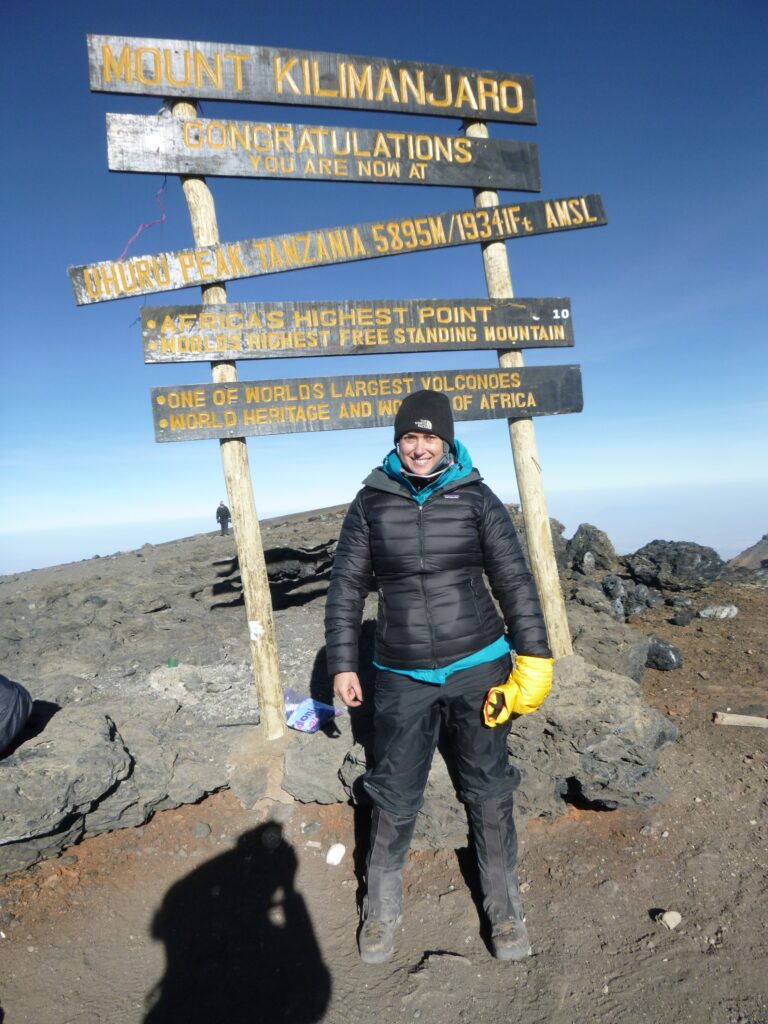
So in 2015, I did something completely out of my comfort zone. I climbed Mount Kilimanjaro. I’ve gone camping twice in my life, and went home early both times. My idea of roughing it is staying at a Marriott instead of a Ritz. And I thought 19,341 feet would be a great idea. Somewhere around 15,000 feet, I wanted to go home. But you know what? You can’t exactly do that. One foot in front of the other, I made it to the summit. I made it to the top as exactly who I am: a mom of six who hates camping.
Everyone on your team has a mountain, a mountain that they want to conquer. They need to know that it’s safe enough to try. Maybe for you, it’s not a mountain. Maybe it’s a conversation that you haven’t had, or the promotion that you haven’t asked for. We need to get weird enough to go after it. We need to get weird enough to share it with our teams.
So that’s my challenge for you. Get weird enough, be real enough, show up at work like you really want to be there, because that’s how we build workplaces where people want to show up, where they really want to stay, and that they’re going to come back to.
Thank you so much. Now go get weird.
[applause]
Sources
- Bravely study, via NBC News BETTER: 7 in 10 Americans are avoiding difficult conversations at work
- MyPerfectResume: HR Perception Survey Finds 86% of Workers Fear Human Resources (2024)
- PCMA Convene: Employees Aren’t Speaking Up at Work, but They Should
How confident is your workplace?
I'm gathering research on confidence at work. Take the one-minute, anonymous Workplace Confidence Survey.
Take the survey