When we talk about what makes a great team, we often jump straight to strategy, systems, and skill sets. We talk about communication frameworks, productivity tools, and performance reviews. But here’s what most leaders overlook: none of those things work the way they’re supposed to if the people on your team don’t believe in themselves.
Confidence isn’t a soft skill. It’s the engine behind every hard result.
I’ve spent years working with leaders and organizations, and the pattern I see again and again is this: the teams that struggle aren’t lacking talent. They’re lacking confidence. And when confidence is missing, everything else suffers, including collaboration, innovation, retention, and trust.
The research backs this up. According to Gallup’s 2025 State of the Global Workplace report, 70% of team engagement depends directly on the manager, and disengagement cost the global economy $438 billion in 2024 alone. That’s not a communication problem. That’s a confidence problem.
What Is Confidence in the Context of Team Building?
Before we go further, let’s get clear on what confidence actually means in a team setting, because it’s not about arrogance or having all the answers. Confident team members don’t think they’re better than everyone else. They simply trust themselves enough to show up, speak up, and contribute without constantly second-guessing their value.
In team dynamics, confidence shows up as:
- The willingness to share an idea even when it might get challenged
- The ability to take ownership of a mistake without spiraling into shame
- The courage to ask for help without worrying it makes you look weak
- The capacity to give honest feedback without fear of damaging a relationship
These behaviors don’t happen by accident. They’re cultivated in environments where confidence is both modeled and encouraged. If you’ve ever wondered whether self-doubt is quietly running the show, the answer in most workplaces is yes.
The Hidden Cost of Low Confidence on Your Team
Low confidence doesn’t always look like someone cowering in the corner. Often it shows up quietly: the team member who never speaks in meetings, the leader who micromanages because they don’t trust their people (or themselves), the high achiever who’s burning out trying to prove they belong.
Consider this: according to the 2025 Gallup engagement survey, only 3 out of 10 employees strongly agree that their opinions count at work. And Mental Health America’s 2024 research found that 63% of Gen Z workers don’t feel confident expressing their opinions at work, while 60% say they can’t be themselves there. That’s not just a wellbeing issue. That’s a performance issue.
Here’s what low confidence costs your organization:
Innovation Slows Down
– When people are afraid to look foolish, they stop bringing new ideas. They default to what’s safe and familiar, even when the team desperately needs creative solutions.
Communication Breaks Down
– Confident teams have honest conversations. Low-confidence teams have polite, surface-level exchanges that leave real issues unaddressed.
Turnover Increases
– People don’t leave bad companies. They leave environments where they feel unseen, undervalued, and unsure of themselves. When confidence crumbles, so does commitment. Gallup research shows that improving psychological safety on a team can reduce turnover by 27%.
Leadership Suffers
– A leader who lacks confidence either becomes a pushover or overcompensates by becoming controlling. Neither version builds a team that thrives. If you’ve ever felt lost at work or struggled to lead from a grounded place, that’s usually the confidence gap showing up.
How Confident Teams Actually Operate
I’ve had the privilege of speaking to and working with leaders across industries, and the high-performing teams I’ve observed share a few things in common. They trust each other. They challenge each other. And they do both without making it personal.
That’s what confidence enables.
When your team is confident, they don’t need to compete for credit because they already trust their own value. They don’t need to tear each other down because they’re not threatened by each other’s success. They can celebrate a colleague’s win without feeling like it diminishes their own.
Confident teams also handle failure differently. Instead of looking for someone to blame, they ask, “What did we learn?” That’s only possible when people feel secure enough to be honest. Gallup research consistently shows that when employees feel their opinions matter and they’re safe to speak up, productivity increases by 12% and turnover risk drops significantly.
The numbers tell a consistent story: when people feel safe enough to be themselves, they perform better.
The REAL Method™ Applied to Team Confidence
In my work, I use the REAL Method™ to help individuals build unshakeable confidence. These same principles apply directly to team culture.
R: Respect Yourself
This starts at the individual level. Team members who respect themselves don’t tolerate being dismissed, but they also don’t dismiss others. When leaders model self-respect, they give their teams permission to do the same.
E: Embrace Your Failures
A team that can’t talk about failure can’t learn from it. Creating a culture where mistakes are treated as data points rather than character flaws is one of the most confidence-building things a leader can do.
A: Ask Yourself What You Want
Confident teams are made up of people who know their own goals and feel empowered to voice them. When individuals have clarity about what they want, alignment becomes so much easier.
L: Live Without Limits
This is where growth happens. When your team stops operating from a place of fear and scarcity, they start thinking bigger. They take smarter risks. They bring more of themselves to the work. Learning to stop struggling with self-doubt is the first step toward living and leading without limits.
Practical Ways to Build Confidence Across Your Team
You don’t need a massive culture overhaul to start shifting things. Confidence builds incrementally, through small, consistent actions over time.
Start With Language
Pay attention to the words your team uses. Words like “just,” “sorry to bother you,” and “I might be wrong, but…” are quiet confidence killers. Encourage clearer, more direct communication without shaming anyone in the process. (This is something I teach through my Drop the Just™ tool, and the change it creates is remarkable.)
Celebrate Effort, Not Only Outcomes
When you only recognize wins, you teach your team to hide struggles. Recognizing the courage it took to try something new, even if it didn’t work, builds a culture where people keep showing up fully. SHRM’s 2025 State of the Workplace report found that 34% of US workers say they don’t feel recognized for their contributions. That gap is costing you more than morale.
Model Vulnerability
From the Top Leaders who are willing to say “I don’t know” or “I made a mistake” create enormous psychological safety for their teams. Vulnerability isn’t weakness. It’s one of the most powerful confidence-builders in a leader’s toolkit. Research consistently shows that psychological safety drives stronger productivity, innovation, and team performance across industries.
Create Space for Every Voice
In meetings, notice who isn’t speaking. Not everyone leads with volume. Make it a practice to invite quieter team members into the conversation, not to put them on the spot, but because their perspective genuinely matters. Part of this is learning to build self-trust so you can extend trust to others.
Invest in Personal Development
Confidence grows when people grow. Training, coaching, mentorship, and keynote experiences that speak directly to self-belief are investments that pay back through engagement, performance, and loyalty. Research shows that highly engaged employees demonstrate 14% higher productivity and 18% higher sales performance than their disengaged counterparts.
The Leader’s Role in All of This
Here’s the truth I share with every leader I work with: you can’t pour confidence into someone else from an empty cup.
If you’re running on self-doubt, imposter syndrome, or the constant need to prove yourself, your team will feel it even if you never say a word about it. The most powerful thing you can do for your team’s confidence is to do your own work first.
That doesn’t mean you need to be perfectly confident before you lead. It means you commit to the ongoing practice of building your own self-belief so that what you model is worth following. How you respond to stress shapes the entire emotional climate of your team, whether you realize it or not.
Confident leaders create confident cultures. And confident cultures create results that no strategy deck or productivity system can manufacture on its own.
Final Thoughts: Confidence Isn’t a Bonus, It’s the Baseline
We tend to treat confidence like it’s the icing on top of good work. Like once everything else is in place, confidence will naturally follow. But in my experience, it works the other way around.
Confidence is what creates the conditions for everything else to work.
When your people believe in themselves, they communicate better. They collaborate more freely. They innovate more boldly. They stay longer, give more, and grow faster.
If you’re serious about building a high-performing team, start with confidence. Not someday. Now.
Frequently Asked Questions
Why is confidence important in team building?
Confidence is what allows team members to speak up, take risks, give honest feedback, and collaborate without fear. Without it, communication stays surface-level, innovation stalls, and turnover climbs. Confidence isn’t separate from performance. It’s what makes performance possible.
What’s the difference between confidence and arrogance in a team setting?
Confident team members trust their own value, which actually makes them more generous with others. They don’t need to compete for credit or tear people down because they’re not threatened by someone else’s success. Arrogance comes from insecurity dressed up as certainty. Confident teams lift each other. Arrogant ones undermine each other.
How does low confidence show up in the workplace?
It’s often subtle. The team member who never speaks in meetings. The leader who micromanages. The high achiever who’s burning out trying to prove they belong. Research from Mental Health America found that 63% of Gen Z workers don’t feel confident expressing their opinions at work, and only 3 in 10 employees overall feel their voice counts. Low confidence is quiet, but its impact is loud.
What can leaders do to build confidence on their teams?
Start with your own. Leaders who model self-trust, embrace failure openly, and create space for every voice give their teams permission to do the same. Small, consistent actions matter too: watching the language your team uses, recognizing effort not just outcomes, and investing in development that speaks directly to self-belief. Gallup research shows that when employees feel psychologically safe enough to speak up, turnover drops by 27% and productivity rises by 12%.
Can confidence be taught, or is it something you either have or you don’t?
Confidence is absolutely a skill, and it can be built at any stage of life or career. I’ve seen it happen at every level, from entry-level employees to CEOs. It requires the right environment, the right tools, and a willingness to do the inner work. That’s exactly what my REAL Method™framework is designed to support, both for individuals and the teams they’re part of.
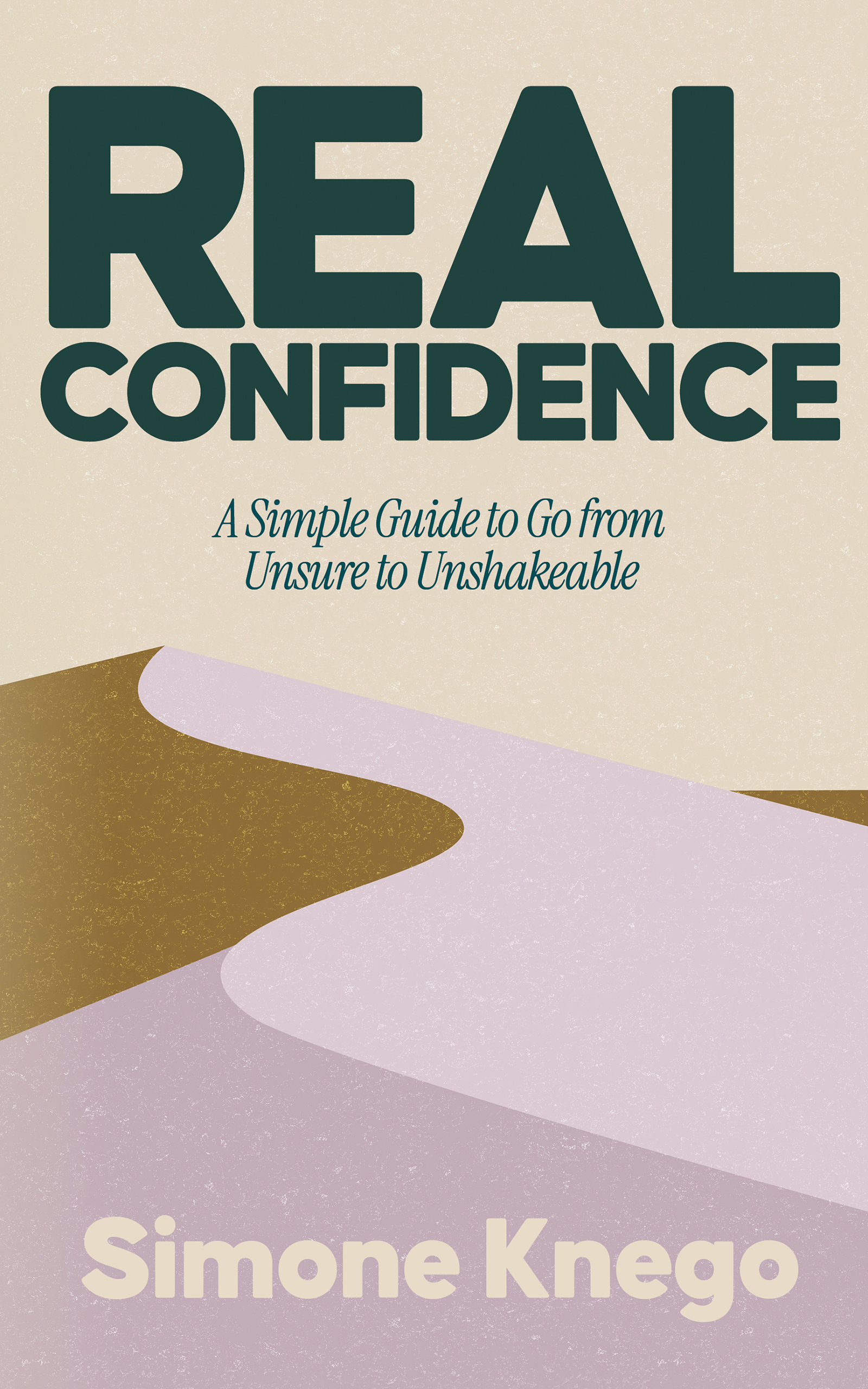
Simone Knego is an international keynote speaker, two-time TEDx speaker, and USA Today bestselling author of REAL Confidence: A Simple Guide to Go from Unsure to Unshakeable. She cohosts the podcast Her Unshakeable Confidence with her daughter Olivia. Simone speaks to corporate audiences, women’s leadership groups, and associations on confidence, self-doubt, and building cultures where people truly thrive. To book Simone for your next event, visit simoneknego.com.